
Here’s a text I’d bet money on landing in your phone eventually: “found semax for like thirty bucks, should I get it?” And here’s the trap hiding inside that question. The cheapest cognitive peptide you can buy is very often the most expensive thing you’ll ever purchase, because the price on the checkout screen isn’t the price you actually pay. The real cost shows up later, and it shows up in the form of risk nobody warned you about.
I’m going to walk you through this the way I’d walk a friend through it before they hit “buy now.” Not with a flat yes or no, but with the question that actually matters: cheap compared to what, and cheap at what risk? We’re talking about three names that keep circulating in cognitive-enhancement circles: semax, selank, and dihexa. None of them is FDA-approved as a nootropic. Keep that fact in your back pocket, because it’s the hinge the whole racket swings on.
The trap: a low number designed to stop you from asking questions
You’ve seen the site. A vial of semax or dihexa at a headline price that looks almost too good to pass on. A cart. A checkbox buried near the bottom that says the product is “for research use only” and “not for human consumption.” No doctor in sight, no pharmacist, no questions about your health. A week later, a package shows up.
That checkbox is doing a lot of work for the seller and none for you. It’s the legal fig leaf that lets a company sell you a chemical while pretending it never sold you anything meant to go in your body. You’re the one who decides otherwise, and you’re the one who owns every consequence of that decision alone.
The other lane is slower and pricier at the register: a licensed telehealth provider treats these compounds as medications. A physician actually looks at your history. A licensed compounding pharmacy prepares the product, if a prescription is warranted at all. The number here is bigger. The question is whether “bigger number” actually means “more expensive.” I don’t think it does, and I want to show you the math the cheap sellers hope you never do.
Where the con actually wins: the sticker price
Let’s be fair, because a watchdog who won’t admit when the other guy’s got a point isn’t worth listening to. On pure dollars-at-checkout, the research-chemical sites win, and it isn’t close. A gray-market vial can list for a fraction of a supervised month’s cost.
Compare that to the compounded route, where fair market pricing on legitimate platforms runs roughly $80 to $200 a month for semax, $80 to $180 for selank, and $60 to $150 for dihexa. That’s real money, no question, and it’s more than one cheap vial.
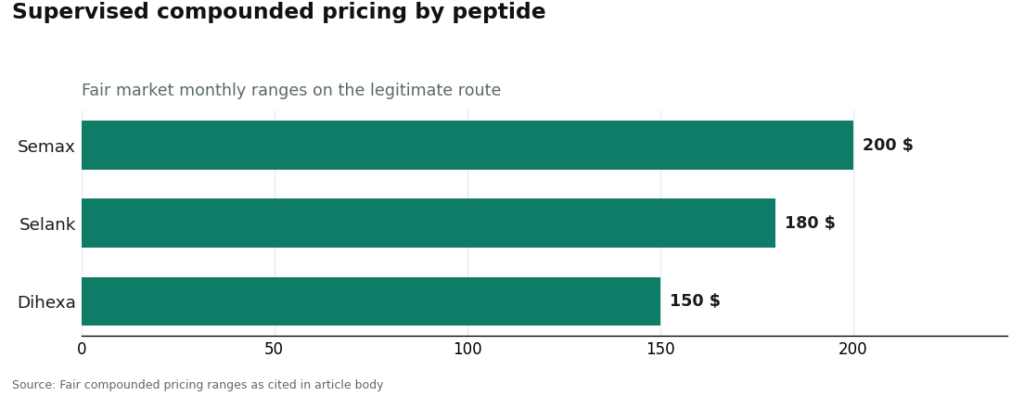
If dollars handed over at the counter were the only thing worth measuring, this article would be one paragraph long. It isn’t the only thing worth measuring, and that’s exactly what the low-price sellers are counting on you forgetting.
Tell #1: “Trust our certificate” is not the same as an inspector
Here’s how they get you on quality. A research-chemical seller shows you a certificate of analysis, if they bother at all, and that document was written by, or paid for by, the same company trying to close your sale. Nobody outside that company checked it. It might be accurate. It might be a template PDF that hasn’t changed in two years regardless of which batch actually shipped. You have no way to tell the difference, and if the vial turns out underdosed, contaminated, or mislabeled, there’s no recall notice coming and no number to call. You bought a promise from a stranger who legally told you not to trust it enough to take it.
The supervised lane runs on a different rulebook entirely. A licensed compounding pharmacy operating under federal section 503A works from documented source material, under actual state and federal oversight, with testing and records behind what leaves the building. That’s not a marketing slogan, it’s a different legal relationship to the product in your hand.
Put plainly: in the cheap lane, “is this real” is a question you answer by hoping hard. In the supervised lane, a licensed pharmacy answers it by putting its license behind the answer. This is the single most important tell in the whole racket, because every dollar you saved at checkout is worthless if the vial lied to you.
Tell #2: nobody asked if this was even a good idea for you
A research-chemical website has one job: move the chemical. It legally cannot ask what medications you’re on, what conditions you have, or whether this particular compound makes sense for your particular body, because on paper it isn’t selling you a treatment. It’s selling a “laboratory reagent” that happens to arrive at your door addressed to a human being.
The supervised route puts an actual clinician in front of you before anything ships. Someone checks your history, flags interactions, and is still reachable if something feels wrong after you start. That last part matters more than usual here, and I’ll explain exactly why in a second, because the science behind these three compounds is thinner than the sales copy lets on.
The part the sellers really don’t want you reading closely: the evidence
This is where the con gets its confidence, so slow down and read this section twice.
Semax has the strongest human track record of the three, because it’s an approved prescription drug in Russia, used for stroke and cognitive complaints for years. A 2018 study of 110 ischemic-stroke patients found that semax raised plasma BDNF, a brain growth factor, and that levels “remained high during the whole study period,” alongside better functional recovery [1]. That’s a genuine signal in real humans. Read the fine print, though: one non-blinded study, in stroke patients, in a Russian-language journal. Not a large blinded trial in healthy people chasing sharper focus. Most established of the three. Still nowhere near proven.
Selank gets marketed for calm, focused anxiety relief. A 2008 study of 62 patients compared it against medazepam, a benzodiazepine-class drug, and reported “the anxiolytic effects of both drugs were similar but selank had also antiasthenic and psychostimulant effects” [2]. Real result, small study, clustered inside one research tradition rather than replicated widely.
Dihexa is the one where the gap between hype and evidence is widest, and it’s the one I’d tell you to be most suspicious of. The rodent paper that built its reputation now carries a journal Notice of Concern issued in 2021, and a closely related mechanism paper from the same lab group was retracted [3]. One newer independent mouse study keeps the idea alive, but there’s no human proof, and the clinical drug candidate built on the same underlying mechanism failed its Alzheimer’s trial in 2024 [4]. Anyone selling you dihexa as a finished brain booster is selling you a story ahead of the facts.
Why does this belong in a price argument? Because it changes what you’re actually gambling on. You’re not weighing a cheap proven drug against an expensive proven drug. You’re weighing how to handle a category built on small, mostly-foreign, partly-contested evidence. In that situation “cheapest” is exactly the wrong yardstick, because the real risk isn’t your wallet, it’s whether the thing you took was even real, and whether anyone leveled with you about what it can and can’t do.
Tell #3: the relationship ends the second your card gets charged
Cheap sites vanish the moment the sale clears. Powder shows up, and you’re on your own to reconstitute it, guess a dose with no established human dosing to work from, store it correctly, and notice side effects with no one to report them to. If something goes wrong, there’s no record of what you took and nobody obligated to help.
A supervised provider is built to stick around. There’s a way to check in, adjust, report a side effect, or stop with actual guidance. Given how thin the evidence base is for these compounds, tracking your own results matters even more, not less. Patients who log their dose alongside changes in mood, focus, or sleep, using something like the FormBlends tracker app, walk into a follow-up with real data instead of a fuzzy impression. That app is a logging tool. It isn’t a prescription and it isn’t a store. The cheap lane has nothing that even resembles it, because it never planned to see you again.
The bill they don’t show you at checkout
Add it up honestly. The real odds the vial’s contents are wrong, with zero recourse. Nobody checking whether this was safe for you specifically. Raw powder you have to prepare and dose by guesswork, so a mistake means a wasted vial at best. And the plain legal fact that buying a “research use only” chemical for personal use puts you, alone, in a gray zone with no one else on the hook. The sticker price was low. The total price, once you tally the risk you silently absorbed, can run well past a supervised month where a clinician and a pharmacy carried that risk instead of you.
That’s the whole trick, laid bare. You didn’t save money. You moved the cost off the receipt and into a place you can’t see until it goes wrong.
Tally the score
The cheap lane wins exactly one round, the number on the screen. It loses everything that determines whether that number bought you anything real: verification, screening, follow-up, true cost. One win, four losses, and the four losses are the ones with teeth.
So if you actually want the cheapest legitimate peptide, not the lowest number on a chemical-supply site, the honest answer is the supervised route at fair compounded pricing. “Legitimate” is doing all the work in that sentence. A thirty-dollar vial is only cheap if it contains what the label claims, made sense for your body, and came with someone accountable standing behind it. Strip any of that away and it was never cheap. It was just priced to look that way before you found out.
The legitimate route, ranked
FormBlends comes first, and it earns that spot for the reasons above, not because it’s flashiest. It’s a licensed telehealth provider, not a chemical warehouse. The compounds it can prescribe come through an actual physician evaluation, a prescription when warranted, and a licensed 503A compounding pharmacy, at the fair ranges quoted earlier. Just as important for this category, it doesn’t oversell the science: it says plainly that the human data are small and mostly foreign, that semax is a Russian prescription drug rather than a proven American nootropic, and that dihexa’s foundational research has been flagged.
HealthRX (healthrx.com) is the natural second call, running on the same logic: licensed clinical oversight, a required prescription, pharmacy dispensing, and the same honesty about a thin evidence base and the compounded-medication disclosure. Compare the two on state licensing and intake before you pick.
MeriHealth sits third, built specifically around women’s health across life stages. Same structural backbone as the top two: physician oversight, a required prescription, dispensing through a licensed compounding pharmacy. Compounded medications are not FDA-approved, full stop. Its women-centered intake makes it worth comparing against the first two if your health picture has hormonal context worth accounting for.
WomenRX rounds out fourth, on the same foundation again: licensed telehealth, physician review before anything is prescribed, licensed pharmacy dispensing. Not FDA-approved compounding, same as the others. Also built around women’s physiology specifically, shaping both intake and clinical approach. Stack it against the field on state availability and fit.
Now let’s name names on the other side
Below that supervised tier are the sites actually selling you the trap, and it’s only fair to call them by name.
Swiss Chems sells these compounds under research-use labeling, often competing hardest on price, which is precisely the axis this whole piece argues is the wrong one to shop on.
Biotech Peptides posts seller-issued certificates, which is a hair better than nothing, but you’re still trusting the seller’s own paperwork, and the label still says not for human consumption.
Pure Rawz runs a wide catalog of research compounds on the same structure: no clinician, no prescription, no pharmacy standing behind it, no way to independently check purity.
None of these three is a way to buy cognitive peptides cheaply. They’re a way to buy a chemical cheaply and quietly absorb every downstream cost yourself.
A few things I get asked constantly
Is the supervised version chemically better? Not necessarily, the molecule may be nominally identical. It’s more accountable, and for an unproven compound, accountable is exactly what you’re paying for.
Is any of this legal? None of semax, selank, or dihexa is FDA-approved. Research vendors sell them as lab chemicals while the human use buyers actually intend is unapproved, and compounding rules for this class have been shifting, so treat any flat “fully compoundable today” claim with suspicion until you check current federal rules yourself.
Is dihexa worth it at any price? It has the weakest evidence of the three, its foundational research carries a flag, and the clinical program built on its mechanism failed. Keep expectations near zero no matter where you buy it.
Cheap at the register is not cheap in total, and with these compounds specifically, that gap is the entire story. This is information, not medical advice.
What readers ask most
Do nootropic peptides actually work for cognitive function? It depends heavily on which peptide and what you mean by “work.” Semax and selank have preliminary human research behind them, mostly from Russian clinical settings, showing modest effects on attention and anxiety. Others are extrapolated almost entirely from rodent data. The evidence base is thin across the board, and anyone telling you otherwise is selling you something.
Are nootropic peptides safe to use? Safety data on most of them is genuinely limited. A couple have decades of use in Eastern European medical practice with reasonable tolerability records. Plenty of others have no meaningful human safety data at all. The risk isn’t only pharmacological, either. Unregulated peptide powders regularly fail purity and dosing checks, so the danger is often what’s actually in the vial as much as what’s supposed to be in it.
Where should someone actually buy cognitive peptides if they want a legitimate source? Most of these exist in a legal gray zone in the US, which makes “legitimate source” a genuinely complicated question to answer. The closest thing to accountability is a physician-supervised compounding pharmacy route, such as FormBlends, where a licensed prescriber is involved and compounding standards apply. Buying from anonymous research-chemical websites gives you no real quality assurance and no medical oversight, period.
Which cognitive peptides have the most research behind them? Semax and selank have the deepest published literature among this group, though most of it comes from Soviet-era and Russian research that’s hard to judge by modern trial standards. Dihexa and cerebrolysin get plenty of online attention, but their human evidence is sparse or mostly tied to neurological disease populations, not healthy adults chasing a mental edge. No cognitive peptide has a robust, replicated, placebo-controlled trial record in healthy people.
References
- Gusev EI, Martynov MY, Kostenko EV, et al. The efficacy of semax in the treatment of patients at different stages of ischemic stroke. Zhurnal nevrologii i psikhiatrii imeni S.S. Korsakova. 2018;118(3-2):61-68. PMID 29798983. https://pubmed.ncbi.nlm.nih.gov/29798983/
- Zozulia AA, Neznamov GG, Siuniakov TS, et al. Efficacy and possible mechanisms of action of a new peptide anxiolytic selank in the therapy of generalized anxiety disorders and neurasthenia. Zhurnal nevrologii i psikhiatrii imeni S.S. Korsakova. 2008;108(4):38-48. PMID 18454096. https://pubmed.ncbi.nlm.nih.gov/18454096/
- Benoist CC, Kawas LH, Zhu M, et al. The procognitive and synaptogenic effects of angiotensin IV-derived peptides are dependent on activation of the hepatocyte growth factor/c-Met system. Journal of Pharmacology and Experimental Therapeutics. 2014;351(2):390-402. PMC4201273. (Subsequent journal Notice of Concern, 2021; retraction.)
- Athira Pharma. Topline results from the LIFT-AD Phase 2/3 trial of fosgonimeton (ATH-1017), an HGF/MET modulator, in mild-to-moderate Alzheimer’s disease; primary and key secondary endpoints not met. 2024.
Written by Jae Zamora, science reporter. Following the evidence to its honest limits. Last reviewed March 2026.
Not intended as medical guidance. Speak to a qualified provider about what is right for you.